

Data Has to Reach the Work
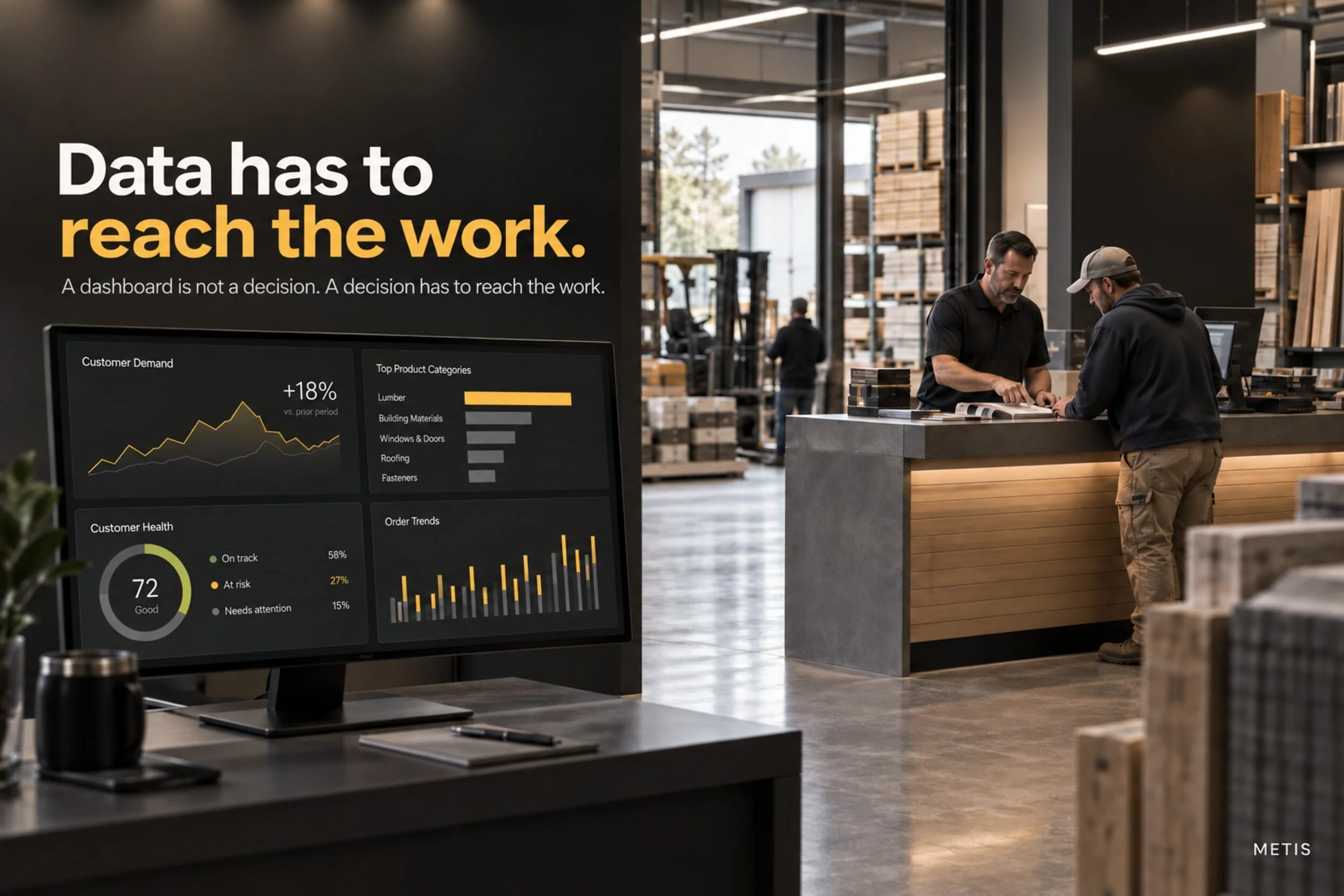
Customer intelligence dashboard beside a building-materials counter where a salesperson works with a contractor, illustrating how data must move from insight into frontline decisions and action.
Why customer intelligence creates value only when it changes what the business does next.
Companies increasingly know more about their customers. They have transaction histories, digital behavior, service records, campaign activity, sales notes, product data, and third-party information. Many have invested considerable time and money connecting at least some of it.
Yet much of that knowledge still does not change what happens next. Sales teams spend time on accounts with limited near-term potential while better opportunities go untouched. Marketing sends customers into journeys that do not reflect what they are trying to accomplish. Ecommerce treats markedly different customers the same. Leaders allocate resources using lagging results because earlier signals never informed the decision.
A company can create a unified customer record, build sophisticated models, and give leaders better dashboards while the commercial organization continues to operate much as it did before. The data exists. The intelligence may exist. But it has not reached the work.
01
The Commercial Gap Is in What Happens Next.
The question is no longer only, “What do we know about this customer?” It is:
What should happen because we know it?
That second question changes the job of data. Instead of producing information for people to review, intelligence begins to support the decisions the business needs to make. Who should sales prioritize this week? Which customers should enter a different journey? Where is an account likely to expand? Which intervention fits this customer now? Where should the company invest its next dollar, hour, or conversation?
02
The Same Intelligence Has to Support Different Decisions.
Decisions occur throughout the business, and the same intelligence may need to take a different form depending on who is using it. A seller does not necessarily need another customer score. The seller may need a prioritized account, a clear reason to call, and the next best action. Marketing may need an audience, a relevant message, and the journey that should follow. Ecommerce may need to recognize what the customer is trying to accomplish and adjust the next experience. A branch may need to know that a customer’s recent behavior suggests a broader opportunity than the purchases visible at that location. Leadership may need to see that one market, customer segment, or growth initiative deserves more investment than another.
The underlying evidence can be the same. The work it informs is not.
03
A Dashboard Is Not the Work.
This is where many otherwise strong data efforts lose momentum. Intelligence is delivered to a dashboard, and the organization is expected to complete the rest of the journey manually. Someone must find the signal, interpret it, determine whether it matters, locate the customer in another system, decide what to do, assign the action, and then somehow track the result.
Every handoff adds delay and inconsistency. The more interpretation and system-switching required, the less likely it is that the intelligence will influence the moment it was intended to influence.
A dashboard is not a decision. A decision has to reach the work.
Reaching the work means putting intelligence into the environments where people and systems already operate. A prioritized account appears in the seller’s workflow. An audience moves into the appropriate marketing journey. An ecommerce experience responds to the customer’s behavior. A service opportunity reaches the person equipped to act on it.
This does not require a company to discard its CRM, ecommerce platform, sales tools, or other operating systems. They can remain systems of record. Intelligence needs to flow into them close to the point of decision, while actions and outcomes flow back into the appropriate operating or customer system.
04
Professional Markets Make the Customer View More Complex.
For manufacturers and distributors serving professional markets, this matters even more because customer behavior is rarely simple. A contractor, installer, or dealer may buy across branches, categories, and channels. The manufacturer may see only part of the relationship because purchases flow through distribution. A distributor may know what an account buys but not what it could buy. An independent rep, branch employee, field seller, and ecommerce platform may each see a different version of the same customer.
The opportunity is not simply to gather those fragments. It is to interpret them with enough professional-market context to determine what they mean. A contractor’s current purchase volume may appear modest while the mix, frequency, and type of work indicate meaningful category-expansion potential. A new customer’s first few transactions may contain early signals that it could become a valuable ongoing account. One pro may be ready to move more business online, while another needs a salesperson or branch employee to remove a very different barrier. An installed-base customer may be approaching a service, replacement, or upgrade need before it becomes an explicit request.
None of those insights creates value by itself. Value begins when the business responds appropriately.
05
The Outcome Has to Come Back.
The workflow cannot end with action. The result of the action has to come back. The complete loop looks roughly like this:
Evidence → Insight → Decision → Action → Write-back → Outcome → Learning
Intelligence supports a decision, which triggers an action through the appropriate person, system, or channel. That action is written back to the appropriate operating or customer system. The business captures the result, and the outcome becomes new evidence for the next decision.
Without that return path, companies may know that an opportunity was identified but not whether anyone acted on it. They may know that a customer received an offer but not whether the offer changed behavior. They may know that a seller called an account but not whether the timing, reason, or recommended action was right.
The outcome is more than proof that activity occurred. It reveals whether the business read the signal correctly and chose an effective response. A result may validate the decision, show that the timing was wrong, or indicate that the customer needs a different intervention. Capturing those distinctions is how a company builds judgment into the system instead of repeatedly acting on assumptions.
06
Better Decisions Belong in the Flow of the Business.
A useful test is whether the organization can follow an opportunity all the way through: from the evidence that surfaced it, to the decision it informed, to the action someone took, to the customer response and the next adjustment. If that chain breaks, the company may be producing intelligence without improving how it operates.
Information becomes valuable when it changes behavior. It becomes more valuable when the result of that behavior improves what the business does next.
The goal is not to put more intelligence in front of the business. It is to put better decisions into the flow of the business, act on them, and learn from what happens next.
The METIS Perspective
Data has to reach the work.
At METIS, this is what we mean by Growth Intelligence for professional markets. The objective is not simply to give manufacturers and distributors more customer information. It is to combine connected data, professional-market context, and decision logic, then move the resulting intelligence into the environments where work happens—in sales, branches, ecommerce, marketing, or service.
That does not require a wholesale re-platform. CRM, ecommerce, sales, and other operating platforms can remain the systems of record. Intelligence can flow into those environments, while actions and outcomes flow back to strengthen what the business understands and what it decides next.
The same intelligence may tell a seller which account to prioritize and give them a reason to call, place a customer into a relevant marketing journey, shape the next ecommerce experience, or help leadership decide where to allocate resources. The expression changes with the work. The discipline remains the same: interpret the evidence in context, make the decision useful, and learn from the result.
The value is not another score, model, or dashboard. It is a business that can turn evidence into action and outcomes into better decisions.
The Signal
Better growth decisions start with better intelligence.
Catch the Signal for practical thinking on Growth Intelligence, professional markets, connected data, AI, go-to-market strategy, and what is changing next.
Catch the Signal. Stay ahead of the noise.
Industry Research
Additional perspectives and industry research supporting the ideas explored in this article:
McKinsey —The Surprising Economics of B2B Growth. Explores the importance of embedding next-best-action intelligence into frontline sales and marketing tools.
McKinsey — The Data-Driven Enterprise of 2025. The importance of moving data beyond reporting and into decisions, interactions, and operating processes.
Distribution Strategy Group — The Future of Analytics in Wholesale Distribution.The need for analytics embedded in distributors’ daily workflows and tailored to different roles.
Distribution Strategy Group — TD SYNNEX Expands Digital Commerce Platform with AI and Sales Automation. Real-world example: customer, pricing, inventory, and quoting intelligence delivered through systems users already work in.